
Information, Comparisons and Buying Tips
Unbiased Mattress Reviews and Pillow Reviews You Can Trust.
MemoryFoamMattress.org was developed in response to the ever-growing number of mattress and mattress pad shoppers who have heard about benefits of memory foam but have not been given enough information to make a proper buying decision. Our goal is to make informed buyers out of every foam mattress shopper. We do this with the help of Dr. Rick Swartzburg, D.C., an expert in the subject of pain relief and proper sleeping posture aids. After several years of research, he has accumulated a vast amount of information on this subject and has figured out how to convey it in a clear and concise manner to help people with this very important decision-making process. The following information will cover everything you need to know about this important subject and offer memory foam mattress reviews of other sites that specialize in these products.
Best Rated Memory Foam Mattress and Pillow Reviews
We have memory foam mattress reviews of various top mattress brands. See also our memory foam pillow reviews, for information, reviews and ratings of the best memory foam pillows available. Our blog has articles about sleep issues, information about mattresses, fillings & materials, and certifications. For help in selecting a mattress, read “Choosing the Correct Mattress and Sleeping Position.”
Top Memory Foam Tips
Frequently Asked Questions
In the early 1970’s, NASA’s Ames Research Center funded a development project designed to create a substance that could help relieve astronauts of the incredible g-forces experienced during lift-off. They believed that one of the key secrets to reducing g-forces on the body was to use a foam material that could conform to each person’s shape and hold this conformity. While a foam mold of each astronaut’s body shape could accomplish this, any movement would take a person out of this position and create incorrect pressure points against the body. Instead, they created a new foam material that was visco-elastic and therefore able to conform to a person’s shape, but then come back to a normal shape once pressure was removed from the foam. This could allow an even distribution of pressure or body weight over the entire surface of the foam, but quickly adapt to any movements of the body.
With this amazing discovery, Fagerdala World Foams of Sweden, one of Europe’s largest foam producing companies, began experiments in the 1980s to perfect it for consumer use.
In 1991, Fagerdala introduced this material in a mattress form to the people of Sweden with very well-received results. In 1992, Tempur-Pedic® launched the same products in North America and experienced a similar response.
With the success of Tempur-Pedic® mattresses, other foam manufacturers in Canada and the United States began to develop their own visco-elastic memory foam material to offer to mattress, upholstering and specialty products companies the ability to allow consumers to have a variety of options and price levels to choose from.
The differences in memory foam will be outlined in the following paragraphs, and will hopefully enable the consumer to make an informed and savvy decision about which foam mattress product best suits their particular needs.
To give a piece of foam memory, you start with a synthetic polyurethane foam material and add certain types of chemicals which add an increase in weight or density to the foam. With the addition of these chemicals, a non-toxic, visco-elastic foam material is created. Visco-elastic can be synonymous with memory foam. Some like to refer to this as “viscoelastic memory foam.” However, there are many features along the way that will help determine what type of memory foam you end up with. To understand exactly what differences are found in each final product, you first have to start with understanding how to grade each foam.e.
With the success of Tempur-Pedic® mattresses, other foam manufacturers in Canada and the United States began to develop their own visco-elastic memory foam material to offer to mattress, upholstering and specialty products companies the ability to allow consumers to have a variety of options and price levels to choose from.
The differences in memory foam will be outlined in the following paragraphs, and will hopefully enable the consumer to make an informed and savvy decision about which foam mattress product best suits their particular needs.
For a material to be visco-elastic, it has to be temperature sensitive and have an ability to rebound fairly quickly and return to its normal shape. Memory foam is graded by its visco-elastic nature and its durability by breaking it down into the following grading system:
1. Weight (Density in pounds per square foot):
The weight of a foam is determined by the amount of chemicals used in the composition of the polyurethane foam. The more chemicals, the higher the density and the more visco-elastic it will become. This density will not determine the hardness of the material; this is done through utilizing the ILD rating structure. Many memory foam mattresses use a 4 and 5-lb. density, but some use as low as 1, 2 and 3-lb. densities.
2. ILD Rating (Indentation Load Deflection):
The ILD rating is going to tell you how hard or soft a material is. The 25% ILD rating is the number of pounds required to achieve a 25% compression of a 4″ thick foam using a 50 square inch indentation. An example of this is as follows: 20-ILD foam indicates that this material took 20 lbs. of pressure to indent this foam 25%. Keep in mind that the higher the ILD, the firmer the foam. This rating is synonymous with the abbreviation IFD (Indentation Force Deflection). IFD is still in use, even though ILD was created just for the purposes of grading polyurethane foam. You can assume that a lower ILD for the top layer of your memory foam mattress or bed topper can be a real advantage in pressure point reduction. However, too soft of an ILD or too thick of a very soft surface layer, especially without enough support underneath, can sometimes be problematic for low back sufferers. That is why the best memory foam mattresses use a layered effect that properly offers a supple enough surface to disburse pressure points, but gradually firms up in the layers below, with a very resilient support base used in the final layer.
3. Resilience:
This measures the foam’s springiness by determining the percent rebound of a steel ball dropped from a height of 36″. The term “H.R” (highly resilient) foam refers to a highly resilient foam that will give a very high “ball rebound” reading. In general, the higher the resiliency, the better and more durable the foam will be with compression forces. However, with viscoelastic memory foam, less resilience indicates a better force dampening. This is due to less rebound pressure fighting the force of your body as it sinks into the mattress. Very high quality memory foam mattresses combine lower high resilient layer(s) with memory foam on the surface, so you get the pressure point reduction, while retaining the extra support below.
4. Tensile Strength:
This indicates the extent to which foam can be stretched, measured in pounds per square inch, and how much elongation in terms of percent of stretch before rupture. This value has little relevance to memory foam mattresses because they are not usually stretched, and will become compressed only when slept on.
* It is important to remember that these ratings can vary from each foam batch that is poured and that no mattress company can predict an exact rating on their mattress each time they produce the final product. As an example, a 10-ILD rated foam could vary from 8 to 12-ILD each time the foam is poured.
While the memory foam that comes from the U.S. does not contain toxic ingredients such as formaldehyde or PBDE (polybrominated diphenyl ether), it can have somewhat of a new foam type of smell that can stay for a couple of days to a couple of weeks, depending on the foam manufacturer. While this smell does not seem to trigger allergies, it can initially be a bother for people who have sensitivity to smells. If you do experience this, here are some tips to help the smell go away more quickly:
• Air out the room and wash the sheets after the first couple of nights sleeping on the mattress.
• Sometimes a dish of vinegar on the night stand can help nullify the odors.
• An ozonator machine will rectify the situation very quickly.
However, if you are worried about the initial smell, there is a new technology memory foam called Biogreen®. This has been tested for V.O.C.’s (volatile organic compounds), the aromatic and often dangerous chemicals, by GreenGuard‘s stringent testing protocol, and it was found to have an unprecedented level that is approximately 13 times below Oeko-Tex, Certipur-US and GreenGuard‘s allowable total of V.O.C.’s required to achieve certification.
One new trend in all bedding is to speak about organic memory foam or green memory foam. While there are ways to make memory foam more environmentally friendly (Biogreen® Memory Foam is one such example), for memory foam to have the same type of visco-elastic feel and support as the original NASA developed formulation it cannot be organic or soy-based (usually 5-10 % soy can be added to memory foam), nor can it be all-natural. However, the memory foam made in the United States has been shown to be safe and non-toxic, and some manufacturers have gone one step further to reduce or eliminate V.O.C. off-gassing odors and other borderline chemical additives.
One of the knocks on memory foam is that it can be hot for some users. This is really due to the very dense nature of memory foam and, consequently, an even a more open cell structure will not breathe very well. This prompted various ideas of how to keep a memory foam mattress cooler, including using a gel infusion with either beads or mixed right into the memory foam itself.
The problem with gel is that it is a conductive substance that responds to the environment around it. This makes it great for those who want to temporarily cool off when getting into bed, but users should know that the coolness won’t last throughout the night, since your body’s heat will warm up the gel more than it would other less conductive substances. Also, gel infusion has not been around long enough to prove its durability and, in fact, it is a well know fact that gel beads easily separate from the memory foam.
Obviously it will be important to allow the memory foam to do what it is best for: Allowing for better contouring of your body shape and therefore less pressure placed on the areas of your body that press harder against the bed. However, don’t just go by your weight, because if you are tall, then your weight is dispersed over the bed more.
A good memory foam mattress will not need a box spring underneath it to make the mattress feel good. You can order a platform base to increase the height of the bed, but remember that this mattress should feel good if it was placed on an even, concrete surface. A good way to test the surface of a box spring or box foundation is to sit or even stand on various areas and see if it compresses underneath you. If you have an existing foundation that is weak, you can easily place two cut 3/4 to 1 inch thick plywood sheets over it to give it the necessary support.
Also, you may want to look at the warranty that a company offers, because you can then worry less about spending extra money for a higher weighted mattress and can attempt to get the correct mattress feel, but save on cost.
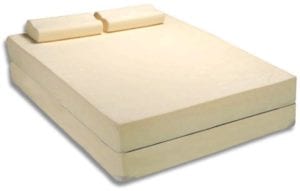
Tempur-Pedic Mattress
The TEMPUR-Pedic original mattress was eight inches thick and had two layers. The top layer is composed of three inches of 5.3-lb. visco-elastic foam that had a listed ILD rating of 14. The bottom layer of the mattress was composed of 5 inches of 3.5-lb., non-visco-elastic, high-density polyurethane foam. It included a cover that is composed of a soft, cotton-like material that was stretchable. To prevent voiding the warranty, TEMPUR-Pedic mandated that their foundation be purchased with their mattress.
TEMPUR-Pedic now offers Tempur-HD, a 7.0-lb. density memory foam that is more temperature sensitive. It will feel firmer until it adapts to your body temperature, especially in cooler room environments. At the end of 2009, they came out with the Cloud Supreme mattress, which utilizes the same multi-density, memory foam layer design of the Tri-Pedic, a mattress that came out from Selectabed.com in 2002. Both mattresses utilize 2 inches of 4-lb. density memory foam that is bonded to 2 inches of a 5-lb. density memory foam. The reason for the 4-lb. density is to offer a less temperature sensitive and a more plush initial feel.
Other companies are now offering a two layer 1-lb. to 8-lb. visco-elastic material and some even offer other types of materials that are layered throughout the mattress. They also offer a wide variety of ILD ratings, but the most common are 8-20.
They are using everything from the thinner cotton and/or bamboo rayon cover to a bulkier wool or quilted cover. While these bulkier covers will feel softer to the touch, the disadvantages are that they will take away from the memory foam feel and contouring of the body. Wool covers will be warmer in the winter and hotter in the summer. The cotton type of covers can wick away moisture, but you may want to get an easily removable one, so you can wash it every so often. They offer thinner and thicker sizes, but eight to 10 inches usually suffices. If you have a solid platform base already, then it is not necessary to order one at the time you make your purchase. However, you may need to order one if you lose integrity in your base down the line.
With all of this said, perhaps the biggest reason many consumers choose to go with a different mattress company would be the price. While TEMPUR-Pedic® is not the most expensive one out there, there are companies offering memory foam mattresses at significant price reductions. When the price is less, it falls on the consumers to do their homework and evaluate the price in relation to the memory foam quality, using measures like density, real 3rd party testing performed on the memory foam, and noting where all the components of the mattress are made, so as to properly discern the true value of the product.
You can browse through a list of mattress companies who offer Memory Foam Mattresses, mattress pads, and other similar products by clicking here.
Deciding on whether you need a new mattress or a mattress pad can be done by realizing what your current bed can offer you. If your current bed is not so old that it has lost its integrity and solidity, then a mattress pad may be just the savings that you are looking for.
An old spring mattress can become “lumpy or bumpy” after many years, thereby making any mattress pad you place over it also “lumpy and bumpy.” You also have to worry about the possibility of sagging, which can cause a dip in the middle of the mattress and thereby cause a trampoline effect. This trampoline effect takes away from the overall support of your spine and can lead to back, neck and other types of painful disorders.
If you determine that a foam mattress pad will work for your situation, then the next thing you will need to do is decide on the same principles that you would need to look at for a memory foam mattress; softness, density, and thickness.
Depending on your existing mattress, you may want anywhere from a one-inch to a four-inch topper, but remember that most standard sheets will not fit over a greater thickness than a ten-inch bed. Two inches thick can suffice if it has enough of an ILD rating, but if it is too hard, then it may not offer that extra measure of body contouring that you are looking for.
It is a complicated scenario to find the best topper for your individual situation because of all the variables, but we have listed sites that you can explore that offer these products by clicking here.
While a spring mattress was the standard for many decades, foam mattresses are becoming more and more popular due to their unsurpassed comfort and overall body support. While spring mattresses can feel nice to sit or lie on, they will not offer anywhere close to the body contouring, and therefore spinal support that memory or latex foam can offer. There is always fiber and some type of foam over the springs, but these coils will actually cause a trampoline effect and bend inward when pressure is applied – without conforming to the specific bumps and curves of the body. While foam can shrink over time, springs can bend and lose their shape over time. Therefore, an old foam bed will likely feel better and offer better support than an old spring mattress.
Latex foam has a higher elasticity or resiliency than memory foam. The result is that latex will feel more springy, and memory foam will feel more solid. Therefore, memory foam will not push back up against your body upon pressure being applied to it. Many mattress companies are using both of these two materials to blend the perfect mattress combination.
Rare allergies to latex can be triggered, but usually upon skin contact, and usually not with the natural and synthetic latex blends like Talalay. This is because the proteins thought to trigger these rare allergies are usually washed away in the Talalay latex foam produced in the U.S. Talalay latex is more supple than Dunlop latex. It is more expensive and is composed of synthetic and natural latex. Because there are no chemicals used in latex composition, it is the ILD only that determines the feel of this product.
Air mattresses have become progressively more popular due to the interesting concept of being able to change the feel of your mattress with a control. With many air mattresses like the leading Select Comfort Sleep Number brand, you can change both sides of the bed to a different firmness. Unfortunately, an air mattress will have many parts that can and often do break. For this reason, you will find the fine print of the warranties to contain less coverage.
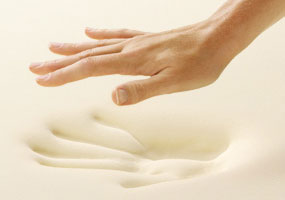
Also, you will not get the same contouring of the body that you can get with memory foam, as air beds will not make an imprint of your body. In fact, it is more similar to a spring bed in that it will cause a trampoline effect and bend inward when pressure is applied without conforming to the specific bumps and curves of the body. This is because air displaces to the sides of the body, leaving the middle with less support.
Memory foam and latex foam are the only substances that can accomplish a contouring of the body without losing support. There are newer technologies in airbeds that offer memory foam in the top layer system, but without the ability to change the pressure of the middle region independently of the shoulder and leg sections of the mattress, a loss of middle support will occur with any reduction in air pressure. Also, many airbeds will not blend well with the memory foam due to a non-flexible chamber system.
When you take into consideration the amount of pressure you place on your shoulder and hips if you are a side sleeper, neck if you are a stomach sleeper, or lower back and sacrum if you are a back sleeper, you will realize that visco-elastic pressure-sensitive memory foam will offer you the best chance for “reducing the overall pressure placed on your joints” by contouring them without pushing back against them. With latex added to a memory foam mattress, it can offer a bit more spring against the concavities like the small of your back or sides, while not losing the ability to contour and displace pressure points.
Sponsor: SELECT-A-BED
Latest Reviews, Ratings, and Comparisons
DreamCloud Mattress Review
DreamCloud Mattress Review DreamCloud Sleep, the high-end business unit of Resident (formly DreamCloud Holdings, LLC), says at the top of its website, “Affordable Luxury Starts With Sleep.” Packed into this short sentence are DreamCloud’s three primary mattress...
RESIDENT DreamCloud Holdings
RESIDENT (formerly DreamCloud Holdings, LLC) DreamCloud Holdings, LLC (DCH) is the corporate umbrella for Nectar Sleep, DreamCloud Sleep, Level Sleep, and AWARA. Its business model is online sales of beds, bedding, and related home products under...
Casper Sleep
Casper Sleep is best known as the shaker-upper of mattress marketing, the company that sparked the current mattress-in-a-box trend.
Nectar Sleep Mattress
Nectar Mattress Review The Company: One of the fastest-rising mattress brands. The Nectar Mattress was launched on September 30, 2016 and is now one of the leading brands in terms of sales. This rivals the rise of Casper Sleep, which entered the bedding market in...
Snuggle-Pedic Mattress
Snuggle-Pedic Memory Foam Mattress Review The Mattress That Breathes with Kool-Flow Ultra-Luxury Bamboo Cover The Snuggle-Pedic mattress was developed by Dr. Rick Swartzburg, a doctor of Chiropractic medicine, to address a growing need in the market for more quality...
Selectabed Memory Foam Mattresses
The memory foam mattresses currently sold on Selectabed are the Tri-Pedic Series, the Memory Zone Series (replacing the SelectaBed 2000 and SelectaBed 5000), and Flex-Tech Elite, the highest model in the Flex-Tech Series (separately reviewed).